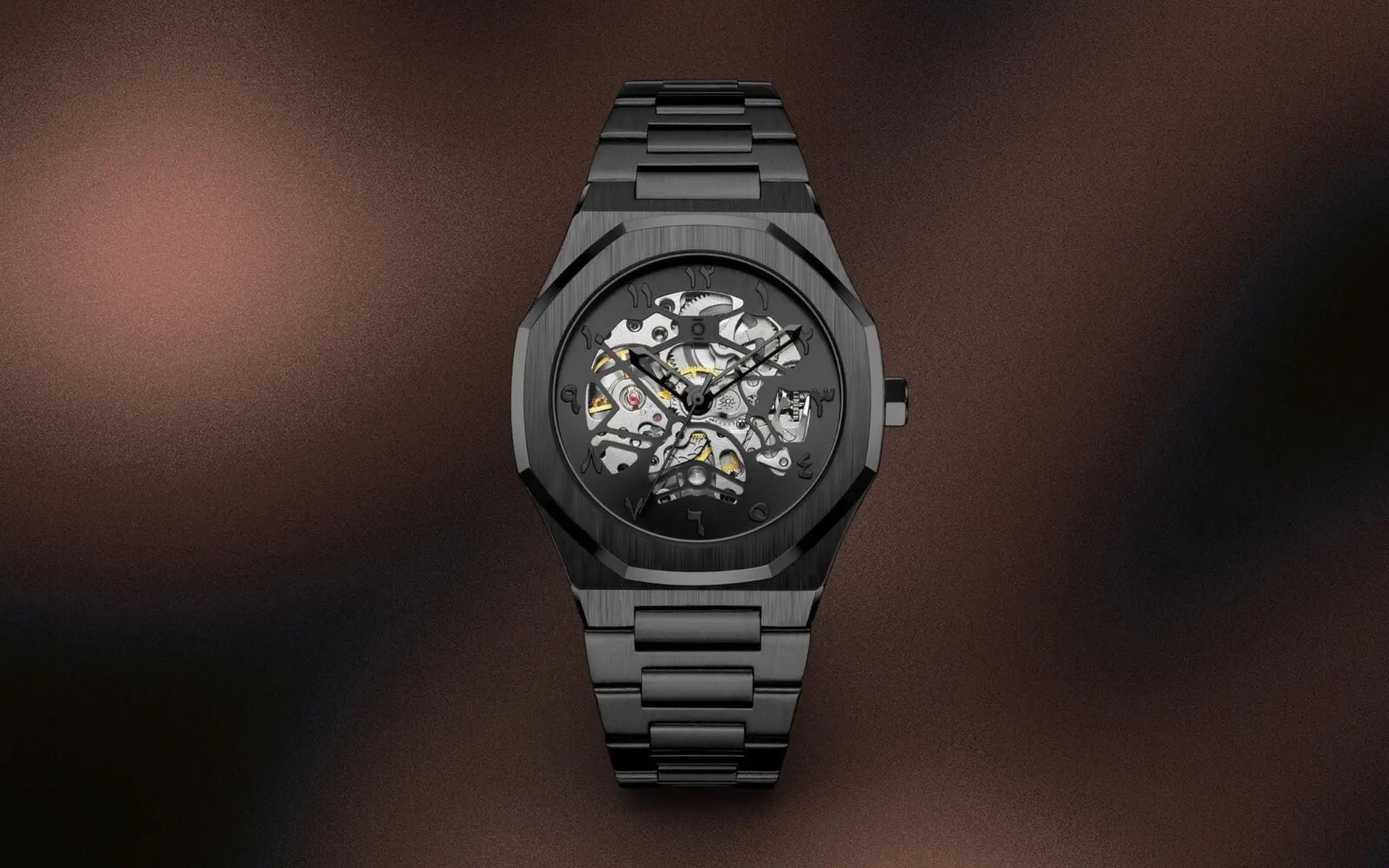

The history of Arabic calligraphy: from reed pen to watch dial
There is a script that has outlived empires.
It has been carved into mosque walls, woven into silk, whispered across trade routes that stretched from Andalusia to the South China Sea. It is one of the most recognized visual systems on the planet — and yet most people have never been taught what it means, where it came from, or why it moves the people who grew up with it so deeply.
Arabic calligraphy is not just writing. It is civilization made visible.
And today, for the first time in 1,400 years of history, it lives on watch dials — carried on wrists in London, Dubai, Toronto, Casablanca, and every city where people carry this heritage with pride.
This is that story.

OWN A PIECE OF HERITAGE
LEGOSS Bundle — Buy One, Get One Free
Two Arabic-inspired watches. One price.

BUILD YOUR BUNDLE : Anniversary Bundle
The Birth of a Script: Arabia Before Islam
Arabic script did not appear overnight. It evolved over centuries from the Nabataean script — used by the traders of Petra in what is now Jordan. The Nabataeans carved their letters in stone and pressed them into papyrus. Their writing was built for speed and commerce.
By the 5th century CE, the Arabic alphabet was forming across the Arabian Peninsula — 28 connected letters, flowing right to left, designed for the sweep of a reed pen. The qalam. The instrument that would build a civilization.

Pre-Islamic Arabia valued poetry above almost everything. The great odes known as the Mu'allaqat were said to hang on the walls of the Kaaba in Mecca. Words had weight. Letters had power. That relationship between script and meaning never weakened — it deepened.
The Qur'an and the Elevation of Script (7th Century CE)
Everything changed with Islam.
The first word of the first revelation — according to Islamic tradition — was Iqra: Read. In a culture built on oral poetry, the written word suddenly carried divine weight. The Qur'an was revealed in Arabic. To write it beautifully was an act of worship.
This single fact transformed calligraphy from a practical skill into a sacred art. Because Islam did not permit figurative imagery in religious spaces, the creative energy that other civilizations poured into painting went entirely into the written word. Mosques became galleries of script.

Qur'anic verses wrapped around domes, climbed minarets, and filled the margins of manuscripts with geometric precision that master calligraphers spent years perfecting.
The reed pen — the qalam — became as sacred as a master sculptor's chisel. To hold it well was a lifetime's work.
The Six Classical Styles That Shaped a World (8th–13th Century)
As Islam spread from Spain to Central Asia, different regions developed distinct calligraphic styles. The great calligrapher Ibn Muqla codified the proportional rules of Arabic script in 10th-century Baghdad — essentially creating a grammar of beauty that calligraphers still follow today.
Naskh:

Thuluth:

Diwani was the Ottoman court script:

Kufic is the oldest formal style:

Nasta'liq developed in Persia and became the dominant script for poetry:

Ruq'ah is the everyday cursive:

Each of these is not just a font. Each is a tradition with masters, students, centuries of refinement, and rules treated as seriously as mathematics.
For centuries Arabic calligraphy appeared on walls, manuscripts, and monuments.
Today it appears on your wrist: Legoss Men’s Watches with Arabic Dials

The Golden Age: When Calligraphy Met Science and Gold (8th–13th Century)
During the Islamic Golden Age, Arabic script became inseparable from the explosion of human knowledge. The House of Wisdom in Baghdad was the greatest library and research center in the world. Scholars translated Greek, Indian, and Persian texts into Arabic — preserving knowledge that Europe's Dark Ages would otherwise have lost entirely.
Every manuscript was written by hand, by calligraphers who understood that how a page looked was as important as what it said. Borders of geometric pattern, columns of perfectly proportioned Naskh, headings in gold Thuluth — a well-made manuscript was art that happened to contain mathematics or medicine or astronomy.
Here is the fact the Swiss watch industry has never acknowledged: Arabic numerals — the 1, 2, 3 on every watch dial in Geneva — traveled from India through Arab scholars into European mathematics. The word algebra comes from Arabic. The word algorithm comes from the name of a 9th-century Arab mathematician. The numbers on every luxury Swiss watch have Arab roots. LEGOSS is simply the first brand honest enough to say so.
Calligraphy Crosses Continents: Spain to China (8th–16th Century)
Arabic calligraphy followed the trade routes — and in each place it absorbed local traditions while maintaining its core identity.
In Andalusia — Muslim Spain — the palaces of the Alhambra

in Granada were covered floor to ceiling in calligraphy and geometric pattern. The phrase Wa la ghalib illa Allah — "There is no victor but God" — repeats across the walls hundreds of times, woven into plasterwork so fine it looks like lace. Visitors from around the world still stand in front of it speechless.
In Persia, calligraphy merged with miniature painting to produce some of the most refined illustrated manuscripts ever made. In the Ottoman Empire, sultans practiced calligraphy personally — master calligraphers were celebrated like military commanders. In West Africa, Arabic script traveled with Qur'anic schools across the Sahara. In Southeast Asia, it was adapted to write Malay and Javanese.
The script traveled further than any army. It was carried by believers, traders, scholars, and poets — people who understood that writing is not just communication. It is identity.
The Modern Renaissance: From Sacred Walls to Gallery Walls (20th–21st Century)
The 20th century brought Arabic calligraphy into collision with modernity. Colonial education systems promoted Latin script. Mechanical printing changed how Arabic was typeset. For a generation, there was a real fear that the living art of the qalam might not survive.
It survived — and it came back stronger.
Contemporary Arab artists like Hassan Massoudy, Khaled Al-Saai, and eL Seed took the script off mosque walls and onto gallery walls, urban murals, and public installations worldwide. eL Seed's

massive calligraphic mural painted across 50 buildings in a Cairo neighborhood became one of the most shared art images of the decade.
A new generation of designers, architects, and brand builders asked the same question every generation has asked before them: how do we carry this forward?
The LEGOSS Answer: 1,400 Years of Script on Your Wrist

When LEGOSS was founded in 2020, the answer to that question was specific and physical: put the calligraphy on a watch dial.
Not as decoration. Not as a cultural touch. As the primary language of the dial.
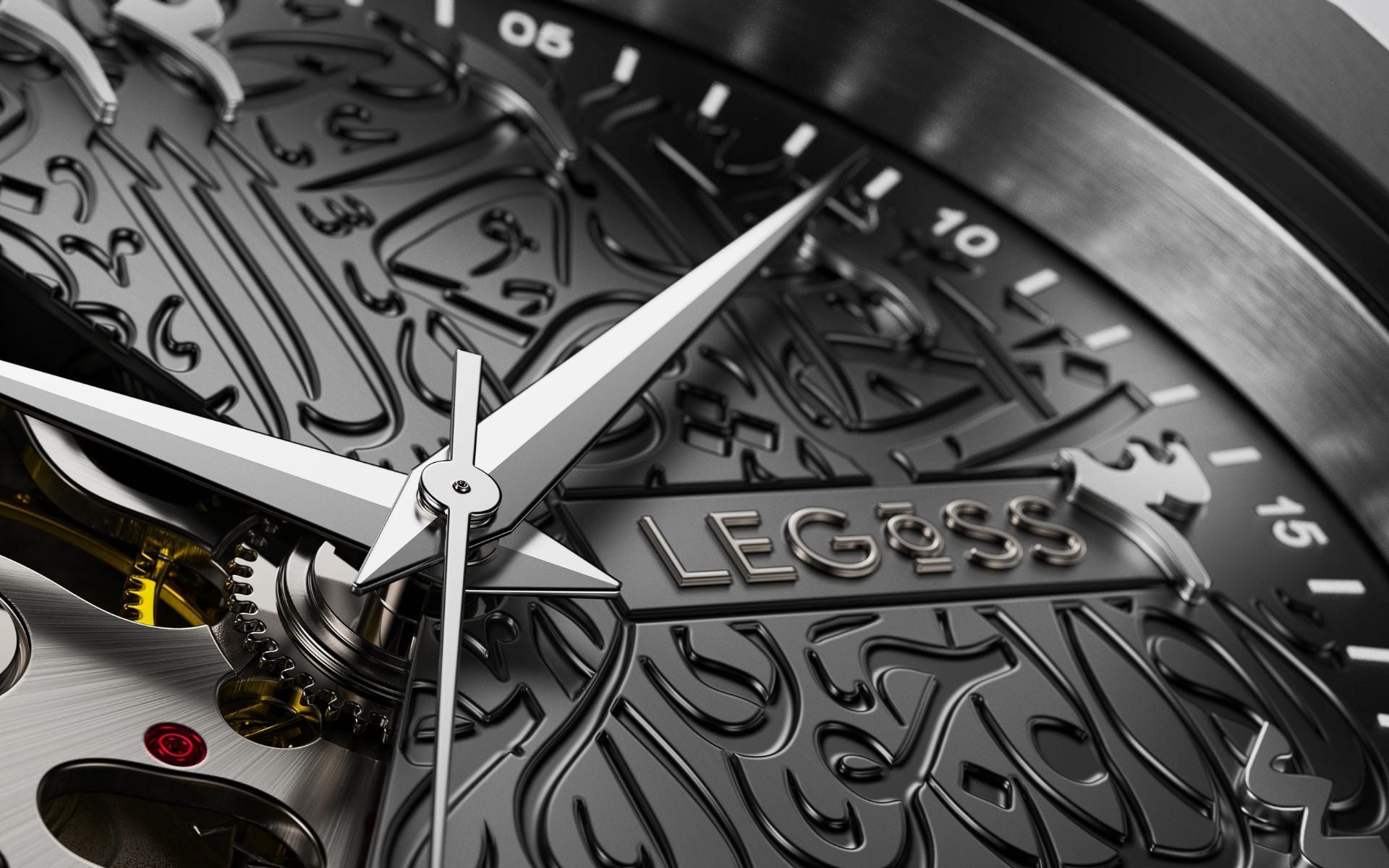
This required real craft. Arabic calligraphy is one of the most technically demanding scripts to miniaturize. The letters connect. They breathe. The curves that a master calligrapher draws with a reed pen in a single flowing gesture have to be translated into metal engraving at 30 to 41 millimeters — a scale that punishes any compromise in design.
Each LEGOSS dial carries a message.

The numerals are not just numbers — they are words and phrases drawn from the deep well of Arabic literary and philosophical tradition. When you glance at your wrist to check the time, you are reading a fragment of 1,400 years of human thought.
For the Arab diaspora wearing a LEGOSS in London or Paris or Montreal, the watch is a quiet act of cultural pride. You do not have to explain it. The script speaks to those who know it — and intrigues those who don't.
Carry 1,400 Years of Heritage on Your Wrist:
 BUILD YOUR BUNDLE: Anniversary Bundle
The Reed Pen and the Watch Hand
The qalam — the reed pen — and the watch hand have more in common than they appear.
Both move across a surface marking time. Both require a steady hand and a clear intention. Both leave a trace that outlasts the moment of their making.
Arabic calligraphy has survived 1,400 years because each generation found a new surface to carry it forward. Stone. Paper. Plaster. Silk. Canvas. A mural painted across 50 buildings in Cairo.
And now — a dial on a wrist.
The script continues.
Ready to wear the tradition? Explore the full LEGOSS collection — free worldwide shipping, Buy One Get One Free, and a 2-year warranty on every watch.